
Architecture isn’t just about constructing functional spaces. Long before psychology or neuroscience existed, architects were already conducting practical experiments on human perception.
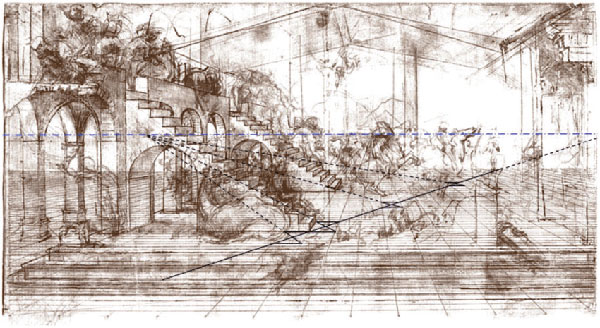
The Greeks discovered that perfectly straight lines often don’t look straight. Renaissance artists developed mathematical perspective to create convincing illusions of depth. Modern architects now use computer modelling to predict how people will perceive space before a building is even constructed.
In that sense, architecture has always been more than engineering. It is also the science of shaping perception. Some architectural illusions are carefully designed. Others happen by accident when sunlight, reflections, or the viewing angle combine in just the right way.
What are the types of architectural illusions?
Architectural illusions are often divided into three broad categories: optical corrections (where architects subtly change a building so it appears normal), geometric illusions (where the shape or perspective of a building creates an unexpected visual effect.), and surface illusions (reflection, color, lighting).
Although these categories use different techniques, they all exploit the same principle: our brains interpret buildings rather than simply seeing them.
1. Optical corrections in architecture.
The Greeks already discovered that perfectly straight lines often don’t look straight. From a distance, the human eye perceives long vertical lines as slightly concave, making the middle appear thinner than the ends.
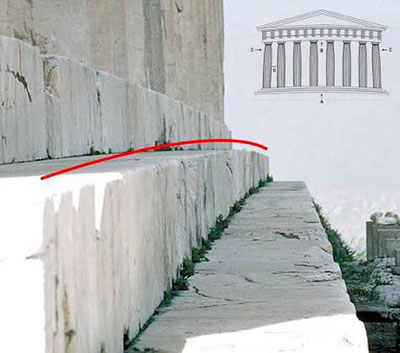
Ancient Greek architects discovered that adding a subtle outward curve to the column made it appear perfectly straight. This tiny correction, known as entasis, is almost invisible when measured but dramatically improves how the building is perceived.
Source: Architecturehub_
The Parthenon in Athens is a famous example of this technique. If the temple was built with perfectly straight lines, it would appear as if the sides curved up and the middle was sunken in. The architects built in a slight upward curve in the stylobate and the columns get slightly wider in the middle to counter visual distortion. Now, the structure looks perfectly straight to visitors.
2. Geometric illusions in architecture
Here the architecture itself creates surprising perceptions. This includes many modern buildings where movement around the structure changes what you perceive.
Illusions used by architects to create surprsing visual effects are:
- Forced perspective
A design technique that manipulates scale and proportion to create optical illusions of greater height, depth, or distance.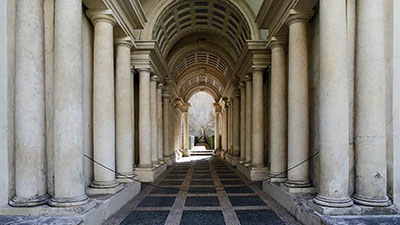
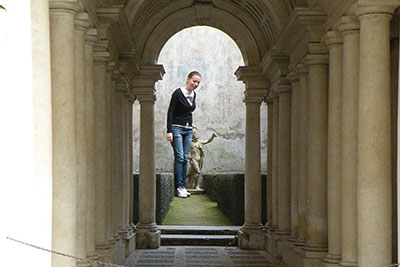
This gallery at the Palazzo Spada in Rome was designed by Francesco Borromini over 400 years ago. It looks like a long corridor with a life size statue at the end. But in reality the gallery is just 8 meters long and the statue is only 90 cm high.
The colomns are actually getting smaller and the corridor more narrow. It is caused by forced perspective. - Anamorphosis
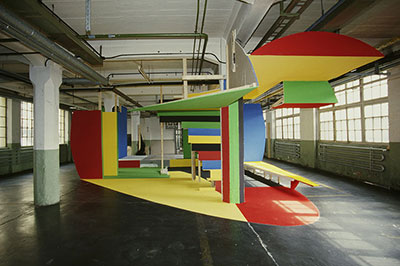
A distorted structure only makes sense from one viewpoint. In architecture it ususally involves murals or LED displays.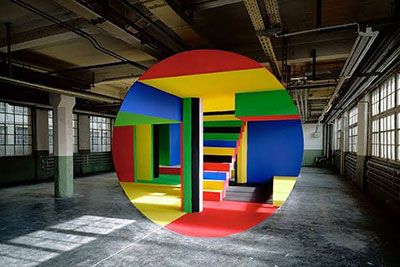
This installation is a work by French artist Georges Rousse, created in Rüsselsheim, Germany, in 2003. The illusion is only visible from a single viewpoint, where all the parts align and form a colorful circle.
Source: Beware - Impossible geometry
Unlike the famous impossible objects of M.C. Escher or the Penrose triangle, real buildings must obey the laws of physics. Architects cannot construct a truly impossible staircase or an endless loop of corridors.Instead, impossible architecture is mostly found in drawings, computer renderings, and optical illusion art, where perspective can be manipulated without the constraints of engineering.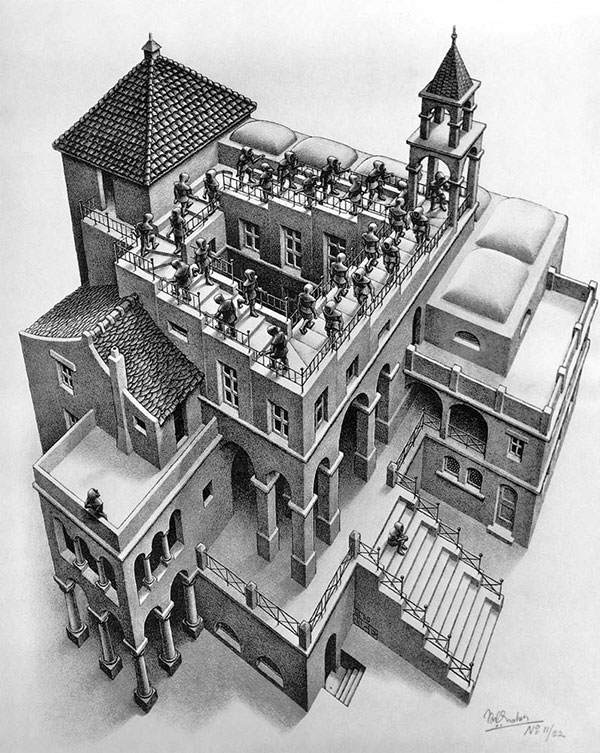
Artists such as M.C. Escher used impossible geometry to create structures that appear perfectly plausible at first glance, yet could never exist in three-dimensional space.
- Parallax effect
Most people think of architecture as something you stand and look at. In reality, architects often design for the experience of walking past a building, where motion parallax, changing viewpoints, and shifting alignments become part of the architecture itself.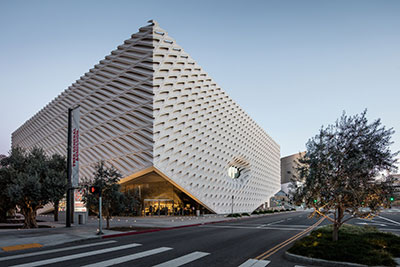 The Broad Museum in LA uses a honeycomb-like veil that shifts the visual depth when you move past it.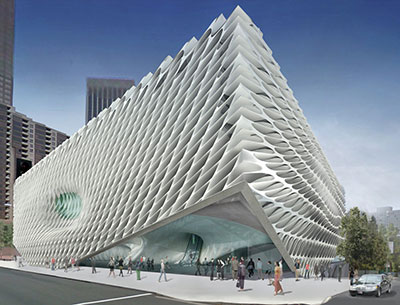
3. Surface Illusions in architecture
While geometric illusions manipulate space, surface illusions manipulate light.
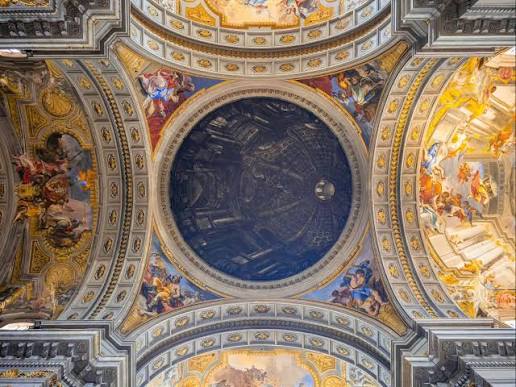
- Quadratura is a style of architectural painting that extends real buildings with painted architecture; false columns, arches, and ledges that seem to physically build upon the real room. Many quadratura works employ anamorphic perspective, meaning they are designed to appear correct only from a specific viewpoint. This combination allows a flat ceiling to appear as a soaring dome or vaulted roof.
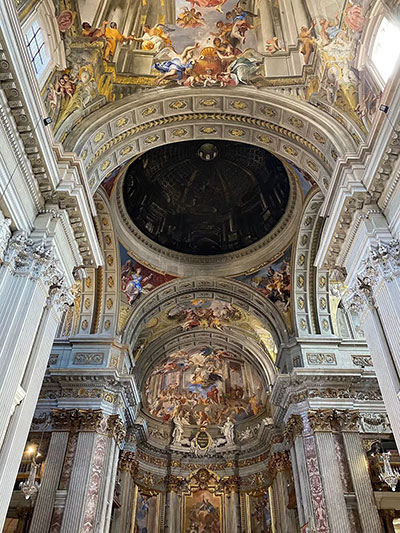
The Church of Saint Ignatius Loyola was originally meant to have a magnificent dome, but the Jesuits unfortunately ran out of money in 1642, and the plans thus had to be scrapped. The ceiling is flat, but the fake dome painted in perspective convinces your brain that there is a deep, vaulted dome overhead.
- Reflection and transparancy
Glass, polished metal, water, and reflective stone all interact with light in ways that can dramatically alter the appearance of a building. A skyscraper may seem to disappear into the sky, reflect another building so perfectly that the two appear to merge, or look almost transparent from one angle and like a giant mirror from another.
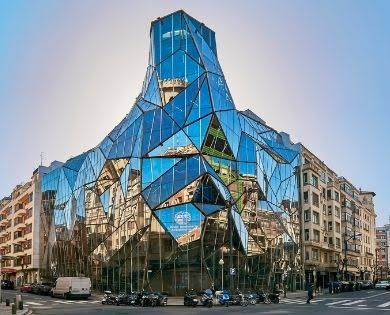 The headquarters of the Basque Health Department in Bilbao was designed by Juan Coll-Bareu blending transparency and reflection to create a space that looks distorted.
Source: Bilbao TurismoDepending on the viewing angle, windows may become almost completely transparent or behave like giant mirrors. This is partly explained by the Fresnel effect, which causes smooth surfaces such as glass to reflect an increasing proportion of light as the viewing angle becomes shallower.
Why our brains are fooled
Architectural illusions reveal an important principle of visual perception. It only interprets it. Your brain doesn’t measure the world with perfect accuracy. Instead, it makes educated guesses based on experience.
It assumes that walls are vertical, floors are level, parallel lines remain parallel, and shadows accurately describe shape. Most of the time these assumptions help us navigate the world efficiently.
Architectural illusions succeed because they deliberately violate one or more of these assumptions without us immediately noticing.
At EyeCon, we’ve collected real-world examples of architectural optical illusions from around the globe. From impossible staircases and perspective tricks to reflections, shadows, and accidental building illusions, each image demonstrates a different way architecture can fool the human brain.