
“When you change the way you look at things, the things you look at change.”
~ Wayne Dyer
As a kid, you have probably noticed that the moon seems to follow you when you’re driving at night.
As you move down the road, trees, houses, and lamp posts race past your window. Mountains drift much more slowly. Yet the Moon hardly seems to move at all, as if it were following you wherever you go.
Obviously, it isn’t.
This effect is called motion parallax. It is one of the brain’s most important tools for judging distance.
What Is Motion Parallax?
Motion parallax is the apparent difference in speed at which objects move across your field of view as you move.
Nearby objects appear to move quickly.
Distant objects appear to move slowly.
Very distant objects, like the moon, barely appear to move at all.
Your brain uses these differences to build a three-dimensional understanding of the world.
So What Is the Parallax Effect?
The parallax effect is the general phenomenon in which an object appears to change position when viewed from different locations.
You can experience parallax by:
- moving your head
- walking through a room
- taking two photographs from different positions
Whenever your viewpoint changes, nearby objects appear to shift more than distant ones. Your brain uses these changes to estimate depth and distance.
Motion parallax simply describes the version that occurs because you are moving.
The Difference Between Motion Parallax and Binocular Vision
People often think we perceive depth because we have two eyes.
That is only part of the story.
Binocular vision compares the slightly different images seen by your left and right eye. This difference, known as binocular disparity, allows your brain to calculate depth.
But this works only over short distances. It is the principle behind stereograms, 3D movies, and virtual reality headsets. Your eyes are too close together to see depth across a field for example. We use other depth cues for that, like parallax. You can see this depth eve with one eye closed.
Together, binocular disparity and parallax form two of the strongest depth cues used by the human visual system.
Why Is the Parallax Effect Important?
Every image that reaches your eyes is flat. Your brain has to reconstruct a three-dimensional world from those two-dimensional images.
The parallax effect provides some of the most reliable information available about distance.
Shadows, color, or perspective can all be manipulated, or misinterpreted (as you can see across this entire site). Parallax is much harder to fake. This is why so many optical illusions stop working the moment you change your viewpoint. Take a little step left or right and shadows, colors or objects no longer align to create that illusion.
Optical Illusions that use the Parallax Effect
There are also optical illusions that depend on controlling, exaggerating, or eliminating parallax.
Hollow Mask Illusion
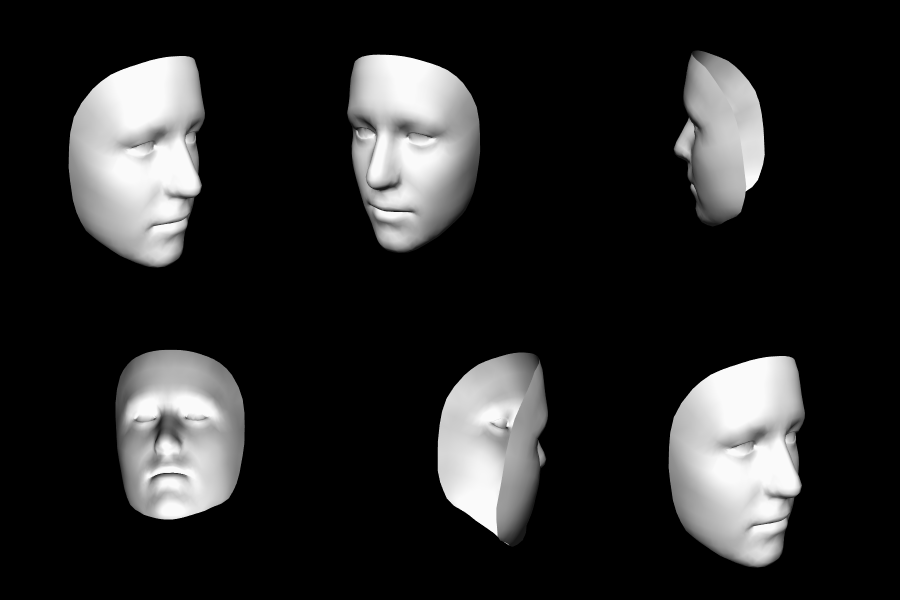
A hollow face appears to rotate as you walk past it.
Normally, motion parallax tells your brain that the nose should move differently from the ears. Because the face is actually inside out, those depth cues are reversed. Your brain refuses to accept the true shape and instead sees a normal face that appears to follow you.
Forced Perspective

Forced perspective photographs carefully position objects so they appear to be the same size or distance.
The illusion works from one viewpoint only. Move the camera, and the normal parallax immediately reveals the true arrangement.
Anamorphic Illusions
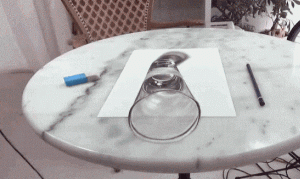
Anamorphic artwork is stretched into strange shapes that only resolve into a normal image from one carefully chosen viewing position.
Once you move away from that point, the illusion collapses.
Ames Room
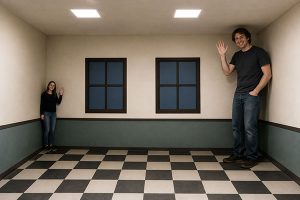
The Ames Room hides its unusual geometry by forcing viewers to look from a single viewpoint. Without changing viewpoints, your brain cannot use parallax to discover that the room is actually distorted.
The Parallax Effect Beyond Optical Illusions
The parallax effect is used in many fields besides psychology.
Astronomers measure the distances to nearby stars using stellar parallax, comparing observations taken six months apart as Earth travels around the Sun.
Video games use parallax scrolling, where background layers move more slowly than foreground objects to create the illusion of depth.
EXAMPLE OF PARALLAX IN WEBDESIGN
Filmmakers often move the camera sideways instead of zooming because motion parallax makes scenes feel naturally three-dimensional.
Self-driving cars and robots estimate distances using cameras that analyse parallax in much the same way our own visual system does.
Astronomy
The parallax effect isn’t just useful for navigating everyday life—it has also helped astronomers measure the vast distances between Earth and the stars.
Imagine holding your thumb up at arm’s length, as a painter would do to measure size in a landscape.
Close one eye and then the other, and your thumb appears to jump against the background. This is parallax: the apparent shift in an object’s position when viewed from different locations.
Astronomers use exactly the same principle. Instead of looking at a star from two different eyes, they observe it from two different positions in Earth’s orbit around the Sun. Six months apart, Earth has traveled nearly 300 million kilometers (186 million miles) to the opposite side of its orbit, providing two widely separated viewpoints.
Nearby stars appear to shift slightly against the much more distant background stars. This tiny apparent movement is called stellar parallax. The closer a star is to Earth, the larger its parallax angle. More distant stars show a much smaller shift.
By measuring this angle, astronomers can calculate the distance to a star using simple geometry. In fact, the astronomical unit called the parsec is defined by parallax: one parsec is the distance at which a star has a parallax angle of exactly one arcsecond (1/3,600 of a degree).
Although the shifts are incredibly small—even the nearest stars move by less than one second of arc—the method has become one of the most reliable ways of measuring stellar distances.
Modern space telescopes such as Gaia have measured the parallaxes of more than a billion stars, creating the most accurate three-dimensional map of our galaxy ever produced.